


In 2022, there are more mobile phones worldwide than there are people, making phone cases essential for smartphones. Custom printing on these cases has become a big business as a result.
For both online and physical shops, offering custom phone case printing can be very profitable. After all, who doesn’t like feeling unique and special?
Personalised phone cases can boost sales because people love having things that are customised. It’s fun and makes them feel more connected to their belongings. Also, printing high-quality designs on phone cases at home is difficult, so it’s best done by professional companies with the right equipment.
Whether it’s for personal enjoyment, business branding, or thoughtful gifts, custom phone cases offer a creative way to express individuality and make lasting impressions.
WHAT ARE CUSTOM PHONE CASE PRINTINGS USED FOR?
Understanding how to print on phone cases is just the beginning. It’s crucial to consider the intended use of your phone case printing. Here are some ideas to inspire you.
PHONE CASE PRINTING FOR BUSINESSES
For businesses, custom phone cases featuring a company logo offer excellent branding opportunities, regardless of the company’s size.
Customers are more likely to engage with familiar brands. Providing employees with custom-designed or logo-printed phone cases ensures brand consistency and enhances the company’s professional image.
Remember, your brand reflects your identity.
Offering high-quality custom phone cases to new contacts helps establish your brand as reliable and trustworthy, which can ease potential business interactions.
Since people check their smartphones an average of 85 times a day, offering a promotional gift like a custom phone case ensures daily visibility and a lasting impression.
PRINTING ON PHONE CASES FOR FUN
However, phone case printing isn’t limited to business; it can also be about personal enjoyment. Displaying your favourite photo on your phone case is a delightful way to lift your spirits every time you use your iPhone.
If you prefer not to have a standard phone case, custom prints or designs allow you to express your individuality and stand out from the crowd. Whether it’s fun designs or personal photos, you can create anything you desire with the right printing company.
Many people see their phones as an extension of their identity. Having a personalised design on your phone case enhances this sense of identity.
GIFTING CUSTOM PHONE CASES
Custom phone cases also make fantastic personalised gifts suitable for all ages and genders.
Giving someone a personalised gift is always special. It can be deeply sentimental and is a meaningful way to show affection. Printing a cherished photograph on a phone case can evoke cherished memories for the recipient.
There’s nothing worse than thinking you’ve found the perfect gift, only to discover someone else had the same idea! Avoid this by giving a custom phone case that not only demonstrates thoughtfulness but is also highly practical and appreciated.
But where do you begin when it comes to getting a personalised phone case printed?
How does the process work?
What types of phone case printing services are available?
Can you print phone cases in bulk or small quantities?
Where can you find phone case printers, and what questions should you ask?
How do you determine the best option for your needs?
If you’re unsure where to start, it might seem daunting. That’s why I’ve created this comprehensive guide. It provides an in-depth look into phone case printing, covering everything you need to know.
Read on to learn all the details about how to print on phone cases, including the printing machine and materials necessary to print on demand.
Chapter 1: Types of Phone Case Printing
Discover the various methods used to print on phone cases, including which types of cases each method can be used for, and whether it offers good value for money. We’ll also explore the pros and cons of each printing method.
Chapter 2: Finding the Right Phone Case Printer
This chapter covers everything you need to know about selecting a printer for your phone cases. Learn about the advantages and disadvantages of choosing a local or overseas printer, where to find them, and the key questions to ask potential printers.
Chapter 3: Selecting Your Printing Service
After reading this chapter, you’ll understand the importance of obtaining pre-production samples. Gain insights into sending your artwork to the printer, avoiding common mistakes, and protecting your intellectual property. We’ll also provide a detailed comparison of ocean shipping versus air shipping to help you decide which option suits you best.
Finally, learn when to initiate the full production process and what information should be included on your purchase order form.
CHAPTER 1: TYPES OF PHONE CASE PRINTING
Choosing the Right Printing Method for Your Phone Cases
When deciding how to print your phone cases, two main factors come into play:
- Your design
- The quantity and style of phone cases you need
Your design dictates which printing method is suitable. If your design is complex with many colours, intricate details, or photographs, you’ll need a method that can handle these requirements. On the other hand, if your design is simple, there’s no need to opt for a more expensive method designed for intricate designs.
The quantity and style of phone cases also matter. Printing methods differ in their suitability for bulk orders versus smaller quantities. Some styles, like rubber IMD cases, require larger orders, while others allow for smaller batches.
In this chapter, we’ll explore different phone case printing methods, covering:
- How each method works
- Compatible phone case styles
- Costs involved
- Advantages and disadvantages
SCREEN PRINTING ON PHONE CASES
Screen printing, also known as silk screening, has a long history dating back to ancient China. This method uses stencils to apply ink onto various materials, from fabrics to phone cases.

How It Works: A tightly stretched mesh screen (traditionally silk, now polyester) is used, with different screens for each colour. Ink is pushed through the stencil onto the phone case, layer by layer, creating the final design.
Compatible Phone Case Styles: Works well with gel/TPU soft rubber cases, as well as hard plastic, wood, and metal cases.
Costs: Ideal for large orders due to setup costs and labour. Costs can be reduced by using fewer colours and ordering in bulk.
Advantages:
- Produces vibrant colours, even on dark backgrounds
- Suitable for high-volume orders
- Offers discounts for large quantities
- Ideal for logos and designs with up to four colours
- High-quality prints
Disadvantages:
- Limited colour options
- Higher cost per unit with more colours
- Not suitable for detailed designs or photographs
- Slow production time
- Less durable, especially on certain materials
Screen printing is best suited for businesses needing high volumes of phone cases with vibrant, simple designs.
DIGITAL UV PRINTING ON PHONE CASES
Digital UV printing uses ultraviolet light to instantly dry and cure ink as it prints onto phone cases. This method, originally developed for drying nail polish quickly, has expanded into industrial and commercial markets. UV lights cure the ink immediately upon printing, preventing smudging and allowing for finer details in designs. The process involves stationary phone cases on flatbed printers, where printheads move over them, enabling multiple layers of printing including white ink or spot varnishes.
Unlike solvent-based methods, UV printing emits very low volatile organic compounds, creating a healthier and odour-free environment for manufacturers. This process ensures durability against wear, scratches, and sun exposure, though designs may scratch off over time since the ink isn’t permanently infused into the cases.
Digital UV printing accommodates high-quality, complex designs on various materials, from wood to metal and plastic. It offers vibrant colours and high-gloss finishes as the UV inks sit on the surface rather than being absorbed, resulting in sharp and crisp images.
Compatible Materials: UV digital printing bonds ink effectively to almost any surface, including wood, metal, plastic, and even unconventional materials like concrete.
Cost Considerations: UV-curable inks adhere well without needing additional coatings, reducing material costs. Faster drying times enhance production speed and efficiency, lowering labour costs. Most UV printing doesn’t require laminating, further reducing production time and expenses.
Advantages:
- Fast curing speeds for quicker production
- High-quality prints with intricate patterns
- Versatile printing on various materials
- Environmentally friendly with low VOC emissions
- Suitable for low minimum orders
- Cost-effective compared to other methods
Disadvantages:
- Print quality, while high, may not match sublimation or IMD/IML printing
- Challenges in printing right up to the edges of phone cases
- Potential for fading over time compared to other ink types
- Limited to printing on pre-made cases
- Designs may scratch off over time
EMBOSSING AND DEBOSSING PHONE CASES
Embossing and debossing are methods used to create raised or recessed designs on phone cases. An embossed design stands out from the case surface, while a debossed design is pressed into it.
Embossing alters the phone case surface by raising a design in three dimensions. It involves two dies: one raised and one recessed, both engraved with the desired design. These dies are used together to press the phone case, imprinting the design permanently.

Debossing is similar but creates a recessed design by pressing the material down rather than raising it up.
There are different styles of embossing to choose from:
Embossing Styles:
- Blind Emboss: Creates a raised design without ink or foil, offering a clean and subtle look.
- Foil Emboss/Print: Uses foil in various colours and finishes (like metallic gold or silver) to enhance the embossed design. Each colour requires a separate run with heated dies.
- Registered Emboss: Aligns the embossed image with an already printed graphic on the phone case.
- Combination Emboss: Combines embossing with foil to create a detailed, two-toned effect.
- Pastelling: Applies a subtle antique finish using pastel or pearl foils.
- Glazing: Creates a shiny finish on the embossed area, best visible on dark-coloured materials.
- Scorching: Uses high heat to create a unique two-toned effect on lighter-coloured cases, though care must be taken to avoid burning.
Compatible Materials: Embossing works best on thin, flexible materials like PU leather and some types of real leather. It’s not suitable for hard, gel, or TPU cases.
Costs: Once the dies are made, embossing becomes cost-effective as the same dies can be used repeatedly.
Advantages:
- Adds depth and detail to designs
- Cost-effective after initial setup
- Offers a variety of styles and patterns
- Quick turnaround once dies are ready
- Consistent quality
- Ideal for subtle branding
Disadvantages:
- Increases printing costs as it’s an off-press process
- Thin details may not emboss well
- Limited to malleable materials
- Cannot reproduce photographic images
- Requires custom-made dies
- Risk of burning cases with certain techniques
HEAT TRANSFER PRINTING ON PHONE CASES
Heat transfer printing involves printing your design onto special release paper using a plastisol-based ink. This ink is thermoplastic, which means it can withstand high temperatures needed to adhere the molecules to your phone cases.
Here’s how it works: your printed design is placed onto the phone case and subjected to high temperature and pressure for a short time. Once cooled, the release paper is removed, leaving your design transferred onto the case.

This method allows for printing complex images, including photographs, in a wide range of colours and intricate designs. The prints are durable, resistant to fading, bleeding, or peeling. However, it’s not suitable for large-scale printing due to its time-consuming nature—each design needs to be handled individually.
Compatibility:
Heat transfer printing works well on various materials such as plastic, metal, leather, polyurethane, and wood phone cases.
Advantages:
- Suitable for printing complex and photographic images.
- Cost-effective for small orders.
- Durable designs that resist peeling, bleeding, or fading.
- Capable of high-quality prints on leather and polyurethane leather cases.
- Can be used on ‘wallet style’ leather cases.
Disadvantages:
- Not practical for large orders due to slow production speed.
- Initial setup costs can be expensive.
2D AND 3D SUBLIMATION PRINTING ON PHONE CASES
Considered to be one of the most advanced printing methods currently available, sublimation is a chemical process whereby your chosen design transitions from a solid to a gas, skipping the liquid stage.
The process begins by printing your selected design or logo onto special transfer paper using dye sublimation inks. The distinction between 2D and 3D printing becomes evident in the next steps.
For 2D printing, the next phase involves a more traditional approach. Your chosen logo or design is applied onto a metal sheet, typically aluminium, and subjected to high temperatures and pressure where the sublimation process occurs. Once the image has transferred onto the metal sheet, it is carefully affixed to a pre-made case, resulting in custom-printed phone cases.
In contrast, 3D printing utilises a special 3D vacuum heat press that enables printing on the sides and back of phone cases. After printing your design onto transfer paper, it is placed onto the phone cases within the vacuum heat press, where the sublimation process occurs. The ink transforms into a gas and solidifies onto the phone cases’ surface.
Sublimation printing ensures extremely durable designs as the ink permeates the phone cases, preventing damage, wear, flaking, or cracking. The continuous tone output during printing results in smoother, brighter colours with greater variation, allowing for high-quality photographic images and intricate patterns.
Suitable Cases for This Printing Method
3D sublimation printing requires phone cases specifically designed for the process; otherwise, they may shrink, which is not ideal. This restricts usage to hard, gel, and TPU phone cases. Unlike traditional methods limited to flat surfaces, 3D sublimation can print on cases with raised surfaces.
Costs, Advantages, and Disadvantages
Advantages:
- Prints with vivid colours
- Can reproduce photographic images and complex designs
- Ensures durability as prints impregnate the phone cases
- Smooth and vibrant colour transitions
- Suitable for hard, gel, and TPU cases
- Ideal for small quantities
Disadvantages:
- More labour-intensive due to additional steps in the process
- Less efficient ink usage
- Expensive, making it unsuitable for large orders; IMD/IML becomes more cost-effective for quantities exceeding 250 phone cases.
WATER TRANSFER/HYDROGRAPHIC PRINTING ON PHONE CASES
Known as water printing or hydrographic printing (also hydro dipping, hydro imaging, fluid imaging), this is a 3D decorating process where intricate patterns like carbon fibre, wood grain, and camouflage can be applied to your phone cases.
Before starting the water printing process, your phone cases undergo pre-treatment with an appropriate primer and base coat. Your manufacturer carefully places a polyvinyl alcohol hydrographic film, featuring your chosen pattern, onto the water’s surface in a dipping tank. This film dissolves after an activator solution is applied.
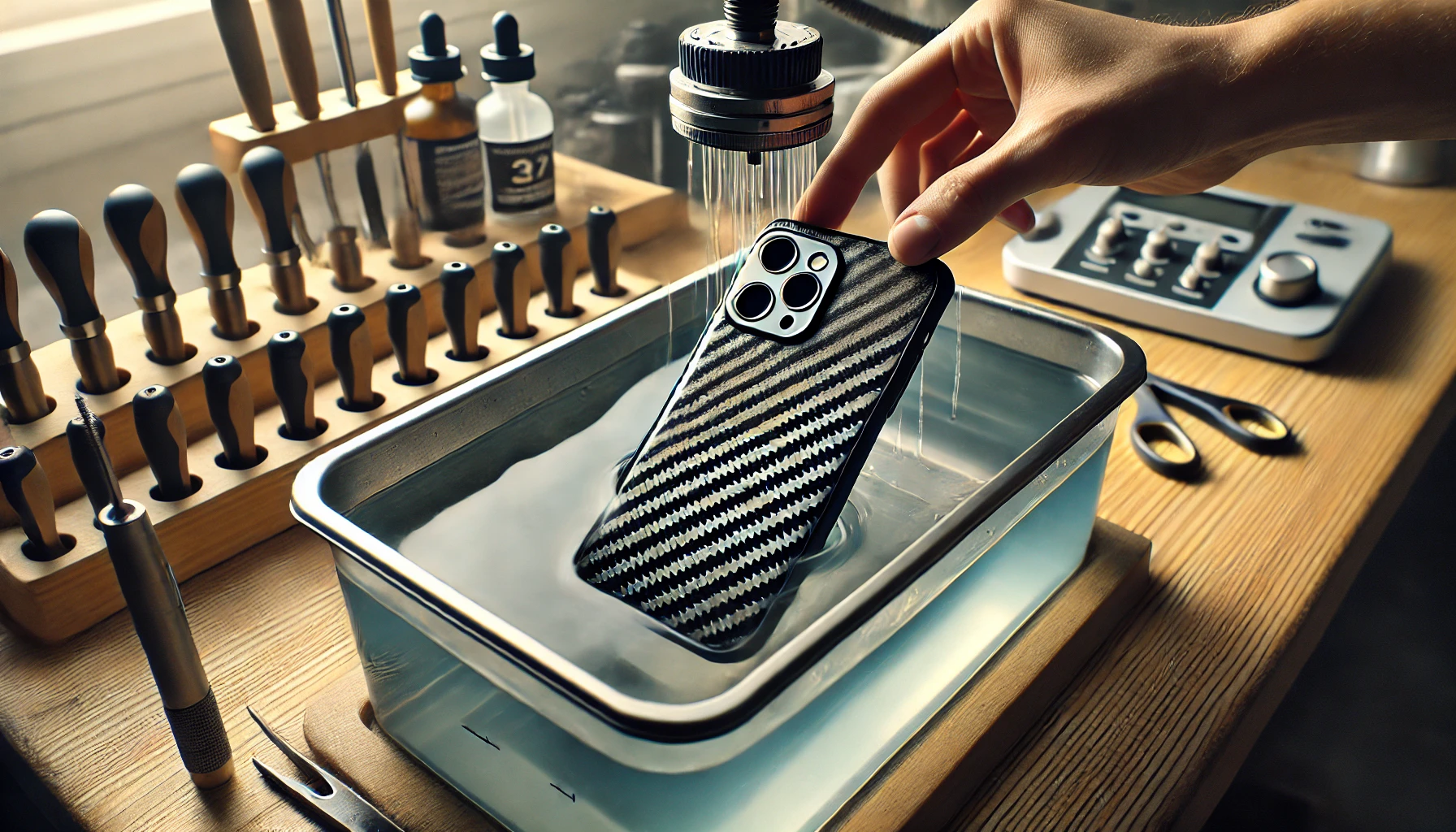
Your phone cases are then dipped into the tank, allowing the pattern to conform to any shape due to surface tension. Chemical components facilitate the transfer of the pattern onto your phone cases. The activator softens the pre-treated layer, ensuring the ink bonds effectively.
After dipping, your phone cases are washed and left to dry.
Finally, a clear topcoat is applied to enhance durability, providing UV resistance and protection against scratches and daily wear and tear.
Suitable Cases for This Printing Method
Hydrographic printing can be applied to a variety of phone cases including plastic, wood, fiberglass, and metal. If your phone cases can be immersed in water, they can undergo this printing process.
Costs, Advantages, and Disadvantages
Advantages:
- Ideal for printing intricate patterns
- Can cover curved and rounded surfaces
- Resistant to UV damage
- Weather-resistant
- Suitable for plastic, metal, and wooden phone cases
- Offers matte or glossy finish options
- Can be cost-effective
Disadvantages:
- Glossy finishes may chip or scratch easily
- Not suitable for gel/TPU cases due to flexibility
- May not achieve the same level of durability as IMD or sublimation cases
IMD/IML PRINTING ON PHONE CASES
In-mold design (IMD) or in-mold labeling (IML) is a process where your phone cases are decorated or labelled during the injection moulding cycle. As your phone cases are being created via injection moulding, your custom design or logo is inserted into the open plastic injection and secured using vacuum ports, electrostatic charge, or other methods chosen by your manufacturer. Once the process is complete, your custom phone case is formed with the design permanently affixed.
This process offers design flexibility and productivity advantages over traditional post-moulding decorating techniques. Your design or logo becomes integral to the case, making it impossible to remove and ensuring long-lasting vibrancy, enhancing the durability of the final product. By integrating decoration during moulding, it also proves to be a cost-effective choice.
Opting for IMD or IML allows for extensive design flexibility with a wide range of colours, effects, textures, and graphics. It can accurately replicate challenging finishes like stainless steel, wood grains, and carbon fibre.
Suitable Cases for This Printing Method
Printing during the moulding process accommodates various phone case styles, including complex designs like wallet-style cases. Materials typically used include hard plastic and flexible TPU cases.
Costs, Advantages, and Disadvantages
Advantages:
- Extensive range of colours, effects, textures, and graphic options
- Long-lasting, vibrant graphics that remain integral to the case
- Eliminates the need for post-moulding decoration, speeding up production
- Ensures consistent quality
- Minimises material waste
- Cost-effective for larger quantities (usually over 250 phone cases per design/style)
Disadvantages:
- Not suitable for small quantities (typically under 250 phone cases per design/style)
- Production time can be longer, depending on order queue
CHAPTER 2: RESEARCHING PHONE CASE PRINTERS

HOW TO FIND PHONE CASE PRINTERS AND SUPPLIERS
When searching for phone case printers and suppliers, you have several avenues to explore to begin your journey. Let’s delve into the best places to start.
Domestic vs. Overseas
Choosing between domestic and overseas suppliers used to be straightforward. Until a few years ago, the default choice was overseas, with China leading the way. However, the landscape has evolved. The US manufacturing sector has closed the gap, trailing China by only 5% in global manufacturing (China 22%, USA 17%). Consequently, prices in the US have become more competitive.
Here’s an overview of the advantages and disadvantages of domestic versus overseas suppliers:
Domestic
A domestic phone case printer or supplier operates within your own country.
Advantages:
- Faster and easier communication without language barriers or time zone issues
- Potential higher perceived value for locally made products, often commanding premium prices (e.g., “Made in USA”)
- Faster and cheaper shipping
- More payment options and no customs fees
- Lower risk of intellectual property theft
- Easier verification of manufacturer and product quality in person
- Better legal recourse in case of disputes
Disadvantages:
- Higher labour costs
- Limited availability of certain product types, especially low-tech items
- Challenges in scaling production for high volumes
Overseas
An overseas phone case printer or supplier manufactures your custom cases outside your home country.
Advantages:
- Lower labour costs (up to 80% less, depending on design complexity)
- Potential for high-quality production with corresponding investment
- Greater choice of companies, accessible through established platforms
- Access to larger workforce, potentially speeding up production
Disadvantages:
- Perceived lower quality for resale items
- Higher risk of intellectual property theft
- Communication challenges due to language and cultural differences (though improving over time)
- Difficulty in verifying manufacturer and product quality
- Higher shipping costs and longer transit times compared to domestic options
- Involvement with customs procedures
It’s beneficial to explore both domestic and overseas options when selecting phone case printers and suppliers. Engaging with representatives from both can aid in making an informed decision.
Where to Look for Phone Case Printers and Suppliers
Directories
Directories offer a cost-effective starting point. Online supplier directories, some of which are free, provide profiles for numerous manufacturers, suppliers, and printing companies. These directories can be invaluable resources for identifying potential partners.
Here are some of the top options for using free online directories to find phone case printers and suppliers:
Alibaba.com (China)
The largest online directory globally for manufacturers and suppliers. Alibaba offers thousands of verified manufacturers with strong performance ratings. They use a trade assurance system to reduce your risk, ensuring a comfortable experience.
Globalsources.com (China)
Alibaba’s main competitor, offering an extensive rating system for manufacturers and suppliers. While it lacks trade assurance like Alibaba, it’s a good alternative with thorough reviews and a broad selection.
Makersrow.com (USA)
Known as “the home of American manufacturing,” Makers Row features over 11,000 US-based manufacturers and suppliers. Detailed profiles help in selecting the ideal partner.
Thomasnet.com (USA)
ThomasNet provides access to approximately 700,000 manufacturers and suppliers in the US and Canada. It offers extensive industrial design resources, including physical publications.
Google Search
A ubiquitous method, Google can lead you to various printers and suppliers. Despite potential SEO limitations on manufacturer websites, persistence beyond the first few pages is often necessary.
Referrals
Networking through social channels and industry connections can yield valuable referrals. Many successful leads originate from recommendations within your professional circle.
Physical Search
For a hands-on approach, visiting potential printing companies in person can provide firsthand insights into facilities, samples, and production personnel. While time-consuming and potentially costly, this method offers unparalleled assurance.
Exploring these avenues and engaging with different companies will likely uncover suitable partners for your phone case printing needs. If a company isn’t the right fit, don’t hesitate to ask for referrals—they often have valuable industry contacts.

Building a Master List of Phone Case Printers
When considering overseas options for phone case printing, follow these tips to streamline the process:
Find Manufacturers in Advance
Utilize platforms like Alibaba, Globalsources, Makers Row, ThomasNet, or Google to compile a list of preferred suppliers for custom phone cases.
Plan Your Questions
Prepare a list of questions using the guidelines from the ‘What to Ask Your Phone Case Printers’ section in this document to ensure you’re well-prepared for meetings.
Set Up Meetings
Arrange meetings with your chosen manufacturers beforehand to save time and avoid unnecessary delays.
Use a Translator (if venturing abroad)
Invest in a reliable local translator if language barriers are a concern during meetings with overseas manufacturers.
Examine the Facilities
Thoroughly inspect the production facilities of potential suppliers and request samples for closer examination before proceeding further.
Build a Master List of Phone Case Printers
While researching potential printers and suppliers, maintain a detailed master list to track your progress and findings. Use platforms like Excel or Google Spreadsheets for easy organisation and accessibility.

Example of Master List Headings:
- Print Supplier’s Name
- Website
- Contact Details
- Date of Contact
- Contact Person
- Notes
Tips for Maintaining Your Master List:
- Keep It Organised: Arrange entries alphabetically for easy reference, or use search functions (Ctrl+F or Command+F) to locate specific suppliers quickly.
- Record Contact Details: Capture essential information such as websites and contact details to facilitate communication.
- Note Key Details: Document conversations and important details under ‘Notes,’ such as follow-up actions or promised information.
- Update Regularly: Continuously update the list as you gather more information and engage with different suppliers to ensure you stay informed and make informed decisions.
Creating and maintaining a master list is a straightforward yet crucial step in efficiently managing your search for the right phone case printer. It ensures you stay organised, up-to-date, and well-prepared throughout the process.
Here’s a comprehensive list of questions to ask your potential phone case printer to ensure you find the best fit for your needs:
- What printing process do you use?
- Understand the method they employ (e.g., sublimation, IMD/IML, water transfer) and its implications for your designs.
- How is the final quality of the printed phone cases?
- Assess the expected quality level based on previous work and customer feedback.
- If there was a problem with shipment, how did you handle it?
- Gauge their responsiveness and accountability in case of logistical issues.
- Were deadlines consistently met? If not, how were delays managed?
- Determine their reliability and contingency plans for meeting delivery schedules.
- Were all promises made during the project fulfilled?
- Ensure they uphold commitments made during the initial discussions.
- How long have you been working with this supplier?
- Understand their track record and longevity in the business.
- How many orders have you placed with them?
- Get an idea of their capacity and experience handling similar volumes.
- Was your contact person easy to work with?
- Assess communication and collaboration with their team.
- Are they responsive to emails and calls?
- Ensure smooth communication channels for ongoing projects.
- What type of printing do they excel in?
- Identify their strengths and expertise in specific printing techniques.
- What types of products have you printed on?
- Ensure they have experience with materials similar to your phone cases.
- Can you send me factory samples?
- Request samples to evaluate their print quality and craftsmanship.
- What are the sample prices?
- Understand the costs involved in obtaining samples for inspection.
- What are the production costs?
- Obtain a detailed breakdown of all costs including production, shipping, and any additional fees.
- What are your file format requirements?
- Ensure compatibility with your design software and file formats.
- Do you provide design templates?
- Templates can ensure accurate design placement and sizing.
- What are your bleed settings?
- Clarify their requirements for bleed to avoid design issues during printing.
- Can I get a sample proof, and is there a cost?
- Request a sample proof of your custom phone case design before full production.
- Will my prints be consistent, and will you notify me of any changes in printers used?
- Ensure consistency in print quality and transparency if any changes occur.
- Is any part of the process outsourced?
- Know if they subcontract any work and understand implications for quality control.
- Will you refrain from editing my design without my approval?
- Clarify your expectations regarding design modifications during production.
- What is your typical production time?
- Understand the turnaround time for your orders.
- Do you have a specialty or niche in phone case printing?
- Determine if they specialize in certain types of phone cases or printing techniques.
- What are your payment terms?
- Discuss payment schedules, methods accepted, and any credit options available.
- Under what circumstances could pricing change?
- Understand factors that could impact pricing fluctuations (e.g., material costs, tariffs).
- What additional fees might I expect?
- Clarify any potential extra charges beyond basic production costs.
- What is the FOB point?
- Determine the point at which ownership and responsibility for the goods transfer from them to you.
- What certifications or standards do you adhere to?
- Ensure compliance with industry standards and certifications for quality and sustainability.
- Which other companies do you print for?
- Assess their client base and reputation based on their portfolio.
- How large is your facility and workforce?
- Understand their production capacity and capabilities.
- What steps do you take to ensure quality throughout production?
- Learn about their quality control measures and checkpoints.
- Will you communicate openly about any issues that arise?
- Ensure transparency and proactive communication in case of challenges or delays.
Important Note: Consistently asking these questions to all potential suppliers will allow you to compare them effectively and make an informed decision. Take your time during this stage to ensure you choose a reliable partner for your phone case printing needs.
CHAPTER 3: CHOOSING YOUR PRINTING SERVICE

Now that you’ve diligently gone through the process of vetting potential printers, receiving and evaluating factory samples, you should have narrowed down your choices to a select few that you’re enthusiastic about working with. The next critical step in the process is to request pre-production samples.
GETTING PRE-PRODUCTION SAMPLES
Obtaining pre-production samples is a pivotal step that should not be overlooked. These samples serve as a crucial validation point to ensure that your chosen printer can indeed produce your designs to your exact specifications.
Patience and Collaboration: Understand that this phase is not only about testing the printer’s capabilities but also about mutual learning. It’s unrealistic to expect perfection on the first attempt, so maintain patience. While some printers may promise to nail it on the first try, the reality often involves iterations and adjustments.
Open Communication: Maintain open and honest communication with your printer throughout the sample evaluation process. When issues arise with the phone case designs, document them meticulously. Take photos, keep detailed notes, and provide clear feedback to the printing service. This collaborative approach is crucial for ironing out any kinks and avoiding costly mistakes during full-scale production.
Time Considerations: Be prepared for this phase to take some time. It’s a necessary part of refining the process to achieve the desired quality. If your chosen printer struggles to meet your expectations, having backup options can be invaluable.
Detailed Specifications: Before production begins, ensure that you provide your printer with detailed and explicit specifications. Never leave anything open to interpretation. Clear specifications will guide engineers, material suppliers, and production teams, ensuring alignment and minimizing errors.
Approval Before Full Production: Never proceed to full-scale production until you are 100% satisfied with the approved pre-production sample. This sample serves as the benchmark against which all subsequent production will be measured.
Conclusion: Pre-production samples are not just a formality but a critical checkpoint in the process of selecting and validating your printing service. By investing time and effort into this phase, you mitigate risks, ensure quality, and set the stage for a successful collaboration with your chosen printer.
TIPS FOR SENDING YOUR ARTWORK FILES
When sending your artwork files to your chosen printer for custom phone case production, following these tips will ensure smooth communication and high-quality results:
- Use Professional Design Tools: Avoid using word processing software for your designs. Use professional design tools specifically created for creating print-ready designs. Software like Adobe Illustrator or CorelDRAW is ideal.
- Convert Fonts to Outlines: Before sending your artwork, convert all fonts to outlines (or paths). This ensures that the text is converted into vector shapes, preventing any font-related issues during printing.
- File Format: Always send your artwork in the format preferred by your printer, usually PDF. PDFs are ideal as they preserve design elements, include crop marks and bleed areas, and maintain the correct resolution for printing.
- Clearly Indicate Cutting Guides: Ensure that your cutting guides are clearly marked and visible in your artwork. Use contrasting colors for the cutting guides to differentiate them from your design elements.
- Use High-Resolution Images: Ensure all images used in your design are high-resolution (at least 300 dpi). Images that look good on screen may not translate well to print if they are low-resolution.
PROTECTING YOUR INTELLECTUAL PROPERTY
During the process of sharing your design files and logos with your printer, it’s natural to be concerned about intellectual property protection. Here are some tips:
- Non-Disclosure Agreement (NDA): Consider having your printer sign a non-disclosure agreement (NDA) to protect your designs and confidential information. This legally binds them to confidentiality and outlines consequences for breaches.
- Legal Assistance: While NDAs offer some protection, enforcing them can be challenging without legal assistance. Evaluate the necessity and feasibility of legal support based on the sensitivity of your designs and the scale of your operation.
SHIPPING YOUR CUSTOM PHONE CASES: OCEAN FREIGHT VS. AIR FREIGHT
Choosing between ocean freight and air freight for shipping your custom phone cases involves considering several factors:
- Cost: Ocean freight is generally cheaper for larger shipments due to lower transport costs per unit. Air freight, while more expensive per kilogram, may be cost-effective for smaller, time-sensitive shipments.
- Speed: Air freight is significantly faster than ocean freight, often delivering within days compared to weeks by sea. Consider your project timeline and urgency when choosing between the two.
- Reliability: Air freight tends to be more reliable in terms of adhering to schedules, as flights operate on daily routes. Ocean freight schedules can be less predictable due to weather conditions and port congestion.
- Environmental Impact: Ocean freight has a lower carbon footprint compared to air freight. If environmental concerns are a priority for your business, choosing ocean freight can align with sustainability goals.

FULL-PRODUCTION
Once you’ve finalized pre-production samples and are ready to proceed with full-scale production, ensure all details are clearly outlined in your purchase order (PO):
- Purchase Order Details: Include comprehensive information such as contact details, company information, shipping terms, quantity, specifications, payment terms, and any quality control requirements.
- Legal Documentation: Ensure your PO is legally binding by having it signed and stamped by both parties. This document safeguards your interests and provides a reference point for any disputes or issues that may arise.
CONCLUSION
Navigating the process of printing custom phone cases involves attention to detail, clear communication with your printer, and careful consideration of logistical and legal aspects. By following these guidelines, you can streamline the process, protect your intellectual property, and ensure the successful production and shipment of your custom-designed phone cases.




The perfect pair! Custom Logo Cases TPU gel Apple iPhone Duo cases are in stock and ready for your custom creation ahead of the Apple iPhone Duo launch 🚀! Connect today for a complimentary proof and rendering. #AppleiphoneDuo #appleiphonecases #iphonecases #customiphonecases #CustomLogoCases ... See MoreSee Less
... See MoreSee Less
... See MoreSee Less